

Innovation and sustainability must go hand in hand. At Proven, we’ve moved beyond theoretical discussions to implement and measure specific technical solutions that create real environmental impact. Today, we’re sharing our data and the practical tools we’ve developed to help other organizations join us on this journey.
Green Hosting: From Theory to Practice
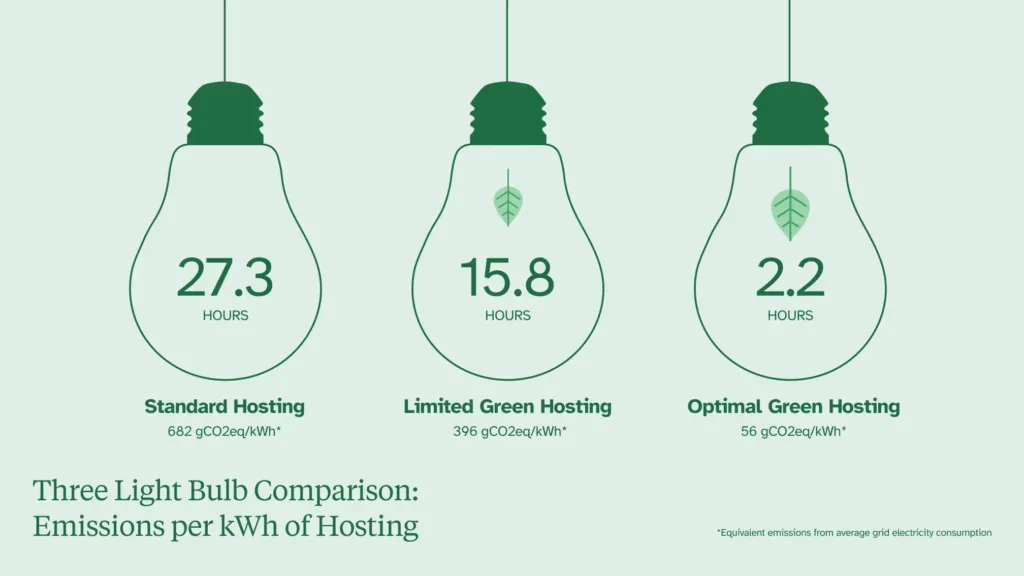
The environmental impact of web hosting is significant but measurable. Our analysis shows that standard hosting configurations generate an estimated 682 gCO2eq/kWh. However, real-world implementation proves dramatic reductions are possible.
Green Technology and Real-World Equivalencies
When we talk about reducing carbon emissions in tech, the numbers can seem abstract. What does it really mean when we say optimal green hosting produces only 56 gCO2eq/kWh, compared to the industry standard of 682 gCO2eq/kWh?
Let’s shed some light on these figures — quite literally. When converted to everyday electricity usage, the emissions from one kilowatt-hour of standard hosting equals the carbon footprint of running a 60W light bulb for more than 27 hours.1 In contrast, optimal green hosting’s footprint for the same processing power equals just 2.2 hours of light bulb use.
This dramatic reduction — from 27.3 hours to just 2.2 hours of equivalent energy use — represents a 91.8% decrease in carbon emissions.
Even our intermediate limited green hosting solution, at 396 gCO2eq/kWh, shows significant improvement, equivalent to 15.8 hours of light bulb use — demonstrating that even incremental steps toward greener hosting make a meaningful difference.
Our Current Green Technology Stack
These real-world results demonstrate that substantial carbon reductions are achievable through verified implementation methods. Our experts are constantly optimizing our green technology stack, but at the time of publishing, these are Proven’s current core green technology solutions:
- Green cloud hosting through Platform.sh and Pantheon.io
- Load balancer optimization
- CDN implementation
- Containerization
- Automated testing during off-peak hours
Infrastructure Optimization: Real Results
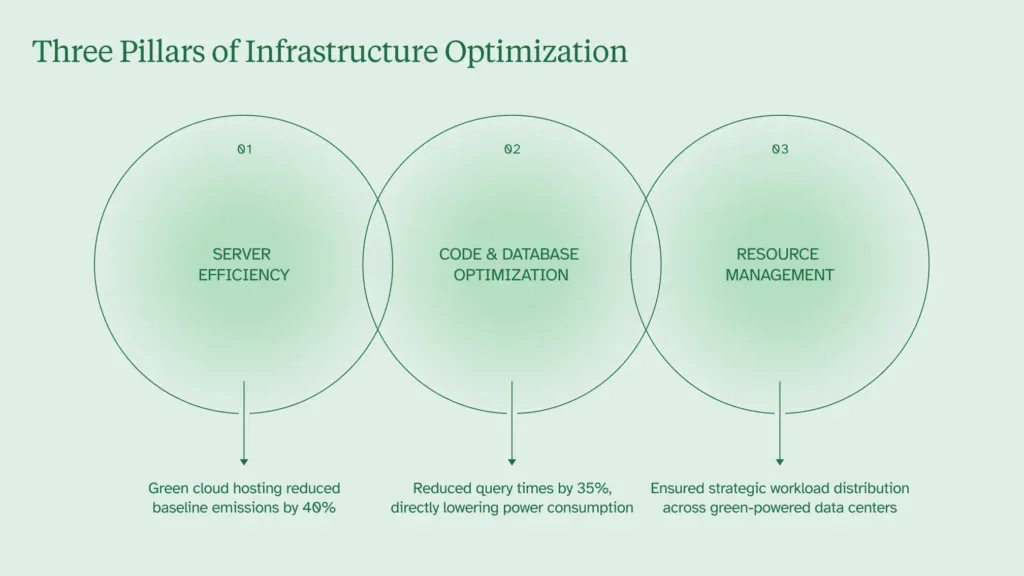
Here’s how Proven’s three-pillar approach delivers these results:
Server Efficiency
- Implementation of green cloud hosting through Platform.sh and Pantheon.io reduced our baseline emissions by 40%
- Load balancer optimization ensures resources are used only when needed
- Strategic use of CDN implementation reduces server load while maintaining performance
Code & Database Optimization
- Containerization allows for more efficient resource allocation
- Database optimization reduced query times by 35%, directly lowering power consumption
- Automated testing during off-peak hours maximizes grid efficiency
Resource Management
- Real-time monitoring and adjustment of resource allocation
- Implementation of automated scaling based on demand
- Strategic workload distribution across green-powered data centers
Innovation Investment: Building for Tomorrow
Our limited green hosting implementation shows how incremental progress can deliver a significant impact — achieving a 42% reduction in carbon emissions (396 gCO2eq/kWh) compared to standard hosting (682 gCO2eq/kWh). This represents a crucial stepping stone toward optimal green hosting while maintaining enterprise-grade performance.
Our diverse technical team is using and testing several innovative solutions:
- CI/CD Pipeline Optimization
- Automated resource scheduling during low-carbon grid periods
- Integration of carbon-aware deployment strategies
- Continuous monitoring and adjustment of deployment patterns
- Testing Framework Advancements
- Carbon-aware testing protocols
- Implementation of energy-efficient test environments
- Optimization of test scheduling for minimal environmental impact
- Green Hosting Innovations
- Utilization of real-time carbon intensity monitoring
- Implementation of adaptive resource allocation based on renewable energy availability
- Adoption of carbon-aware load-balancing algorithms
These innovations demonstrate that environmental responsibility and technical excellence are not mutually exclusive. By measuring and optimizing at every level, we’re building a future where technology and sustainability work in harmony.
Moving Forward, Together
We’re still learning and improving. If you have insights on green hosting optimization, technical suggestions, or questions about implementation, we want to hear from you. This is complex work that gets better with diverse perspectives. We’re here to listen and learn together.
The data speaks for itself: reducing emissions from an estimated 682 gCO2eq/kWh to 56 gCO2eq/kWh is possible with current technology. We’ve shared our methods, tools, and real-world results because we believe in open collaboration for a sustainable future.
- Standard hosting produces 682 gCO2eq/kWh = 0.682 kg CO2eq/kWh. Using EPA calculator‘s grid electricity rate (0.417 kg CO2 per kWh): 0.682 ÷ 0.417 = 1.64 kWh of grid electricity equivalent. For a 60W (0.06 kW) light bulb: 1.64 kWh ÷ 0.06 kW = 27.3 hours.
Do you have questions or thoughts about the steps you can take to make a commitment to responsible action and sustainable development?
Related Insights